GAL02 - How Can Marine Data Improve Freshwater Access for Coastal Communities?
- Futuora
Galle
- Individual
- Janitha Dissanayake
Millions of people in coastal and fishing communities lack access to safe drinking water, despite living beside the ocean. Compact reverse osmosis (RO) desalination can help, but deployment needs data as well as hardware — and so does keeping boats running safely out on the water.
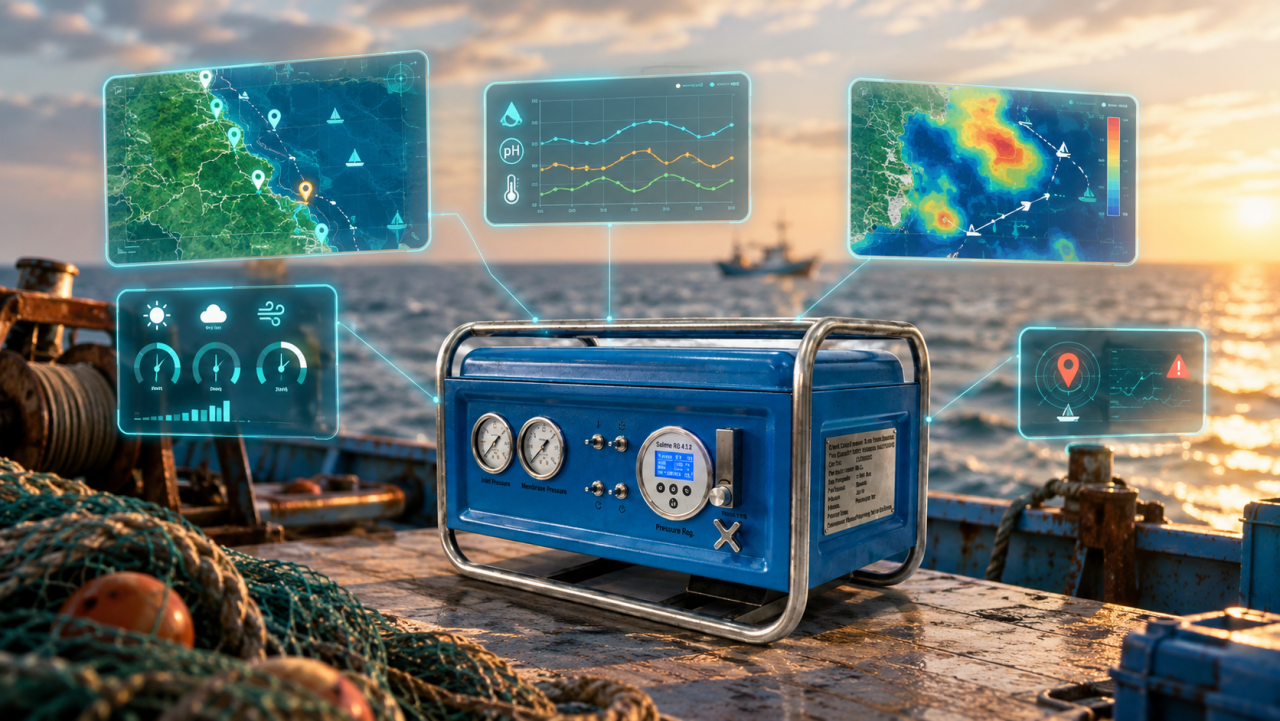
Futuora's field-tested portable RO desalination unit is now instrumented to report pH, salinity, water temperature, water usage, RO power draw, solar/wind conditions, GPS location and timestamp directly from the boat, alongside onboard sonar fish-finding data and winch-operation signals. Combined with satellite weather data and water-quality sensors placed in coastal rivers (water level, salinity, pH, temperature, GPS), this gives the hackathon a real, multi-source dataset to build on, not a hypothetical one.
The challenge: turn that data into a support platform serving fishermen, boat owners, and local authorities, helping decide where and when desalination is needed most (including priority sites like hospitals and schools), keeping boats safer and more efficient at sea, and giving fleet operators real-time visibility into their vessels.
You want to join the team:
- What the challenge owner would like to develop over 48h
A proof-of-concept decision-support and fleet-management platform, built on real onboard and environmental data, covering as many of the following as the team can realistically reach:
1. Efficient use of RO — recommend where to draw intake water and when to run the pumps, optimizing energy consumption against measured conditions (pH, salinity, water temperature, RO power draw).
2. Groundwater-level & priority-deployment prediction — combine real-time river water-quality data (water level, salinity, pH, temperature) with measured RO-unit output to estimate groundwater conditions in coastal communities, and prioritize where and when desalination is most needed (e.g. hospitals, schools).
3. Fish habitat heat map & boat path planning — identify the best fishing areas from sonar fish data, GPS, and winch-operation signals, and plan an optimal route to reach them.
4. Boat-to-boat mesh network — a local mesh connecting boats to relay encrypted data between vessels and back to shore/cloud where direct connectivity isn't available, using blockchain-style distributed data handling.
5. Boat fleet management for owners — SOS alerts, malfunction flags, and detection of abnormal fishing patterns or restricted-zone entry, from the same GPS/winch/sonar signals.
6. Interactive weather & safety map — help decide safer areas and times to deploy boats or fish, and safer siting for desalination units.
Data available to the team: onboard RO-unit sensors (pH, salinity, water temperature, water usage, RO power, solar intensity, wind, winch operation, sonar, GPS, date/time), satellite weather data, and river water-quality monitoring stations (water level, salinity, pH, GPS, water temperature).
- Which skills the challenge owner is looking for
- We welcome participants from diverse backgrounds who are interested in applying marine data to solve real-world water challenges. The following skills would be particularly valuable:
Software Developer (Web, Mobile, or Full-Stack)
Data Scientist / Data Analyst
GIS & Geospatial Engineer
Oceanographer / Marine Scientist
Environmental Engineer
AI / Machine Learning Engineer
Remote Sensing & Earth Observation Specialist
UX/UI Designer
IoT & Embedded Systems Engineer
Hydrologist / Water Resources Engineer
Climate Data Specialist
Fisheries or Coastal Community Expert