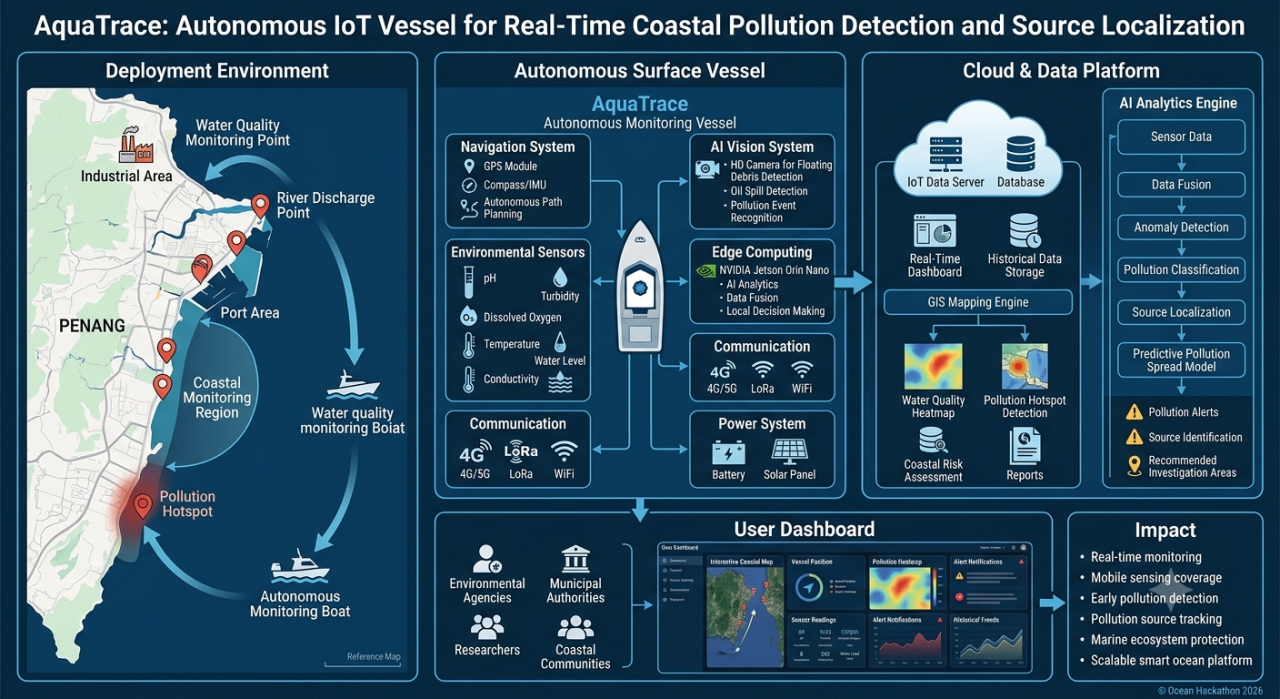
KUL01 - AquaTrace: Autonomous IoT Vessel for Real-Time Coastal Pollution Detection and Source Localization
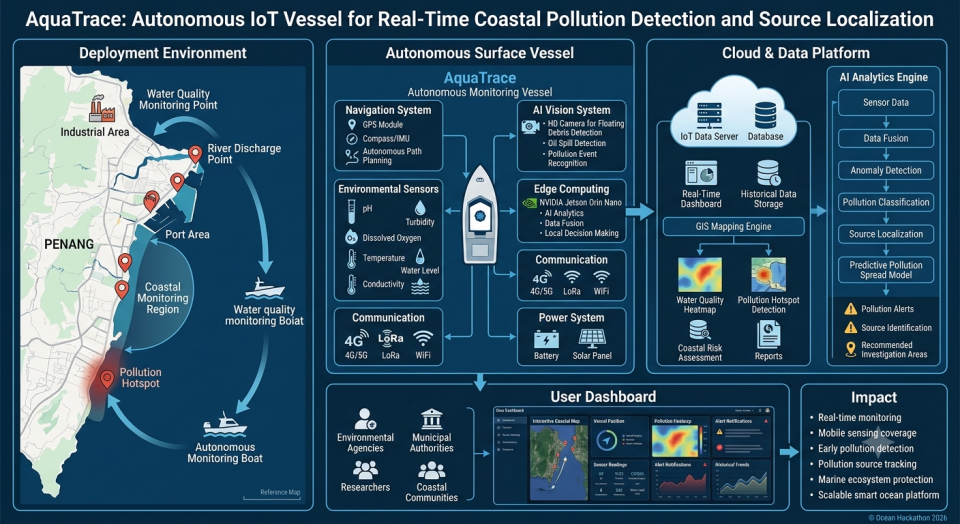
- © 2026 AquaTrace Project Team. Generated with AI design assistance (Gemini)
Kuala Lumpur
- Individual
- Yi Xian Phi
Marine pollution is one of the biggest threats to our oceans, yet most coastal monitoring systems still rely on fixed stations that can only observe a small area. When pollution events occur, whether from industrial discharge, urban runoff, illegal dumping, or maritime accidents, authorities often discover them too late, after environmental damage has already spread. Along the Penang coastline and many other coastal regions, there is a lack of affordable, real-time, and mobile monitoring solutions capable of identifying where pollution originates and how it spreads. Current monitoring approaches provide isolated data points rather than a complete picture of water quality conditions. Our challenge is to develop AquaTrace, an autonomous IoT-powered surface vessel that acts as a "smart ocean scout." Instead of waiting for pollution to reach a fixed monitoring station, the vessel actively navigates coastal waters, collecting real-time environmental data such as pH, turbidity, dissolved oxygen, conductivity, temperature, and water levels. By combining autonomous navigation, sensor fusion, cloud connectivity, and AI analytics, the system will generate live water quality maps, detect pollution hotspots, and help identify potential contamination sources. The long-term vision is to create a scalable network of intelligent monitoring vessels that can support environmental agencies, researchers, and local communities in protecting marine ecosystems. We're looking for teammates interested in robotics, IoT, AI, software development, environmental science, data analytics, and product design to help transform this idea into a real-world solution for smarter ocean conservation.
You want to join the team:
- What the challenge owner would like to develop over 48h
- Over the 48-hour hackathon, we aim to develop a working prototype of AquaTrace, an IoT-enabled mobile water quality monitoring system.
We will build a small-scale autonomous or semi-autonomous boat (or simulation) equipped with environmental sensors to collect real-time data such as pH, turbidity, temperature, and conductivity. The data will be transmitted via IoT (ESP32-based system) to a cloud platform.
We will also develop a web dashboard that visualizes live water quality readings, vessel location, and pollution heatmaps, along with basic AI-based anomaly detection to identify potential pollution events.
The final demo will show an end-to-end system: sensor data → mobile vessel → cloud analytics → real-time visualization, demonstrating how mobile monitoring can improve coastal pollution detection compared to static stations.
- Which skills the challenge owner is looking for
- IoT / embedded systems engineer (ESP32, sensors, hardware integration), robotics / autonomous systems developer (navigation, control), full-stack developer (web dashboard, backend, real-time data), data scientist / AI engineer (anomaly detection, pollution analysis), GIS / geospatial developer (mapping, heatmaps, localization), UI/UX designer (dashboard visualization and user experience), environmental / marine science domain advisor (water quality interpretation)