CHE03 - BlueGrid: Optimal Hybrid Renewable Energy Planner for Island Microgrids
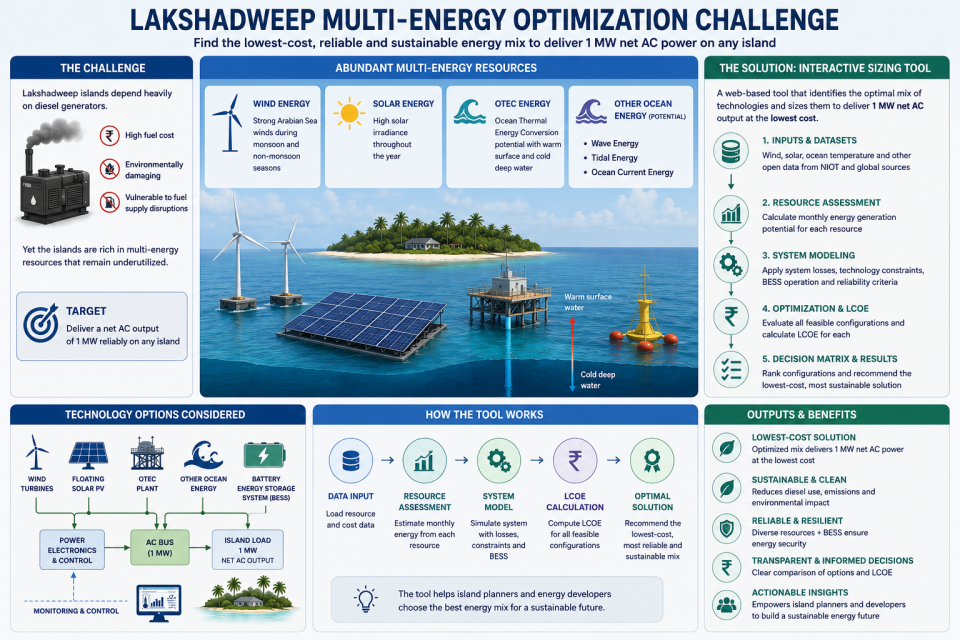
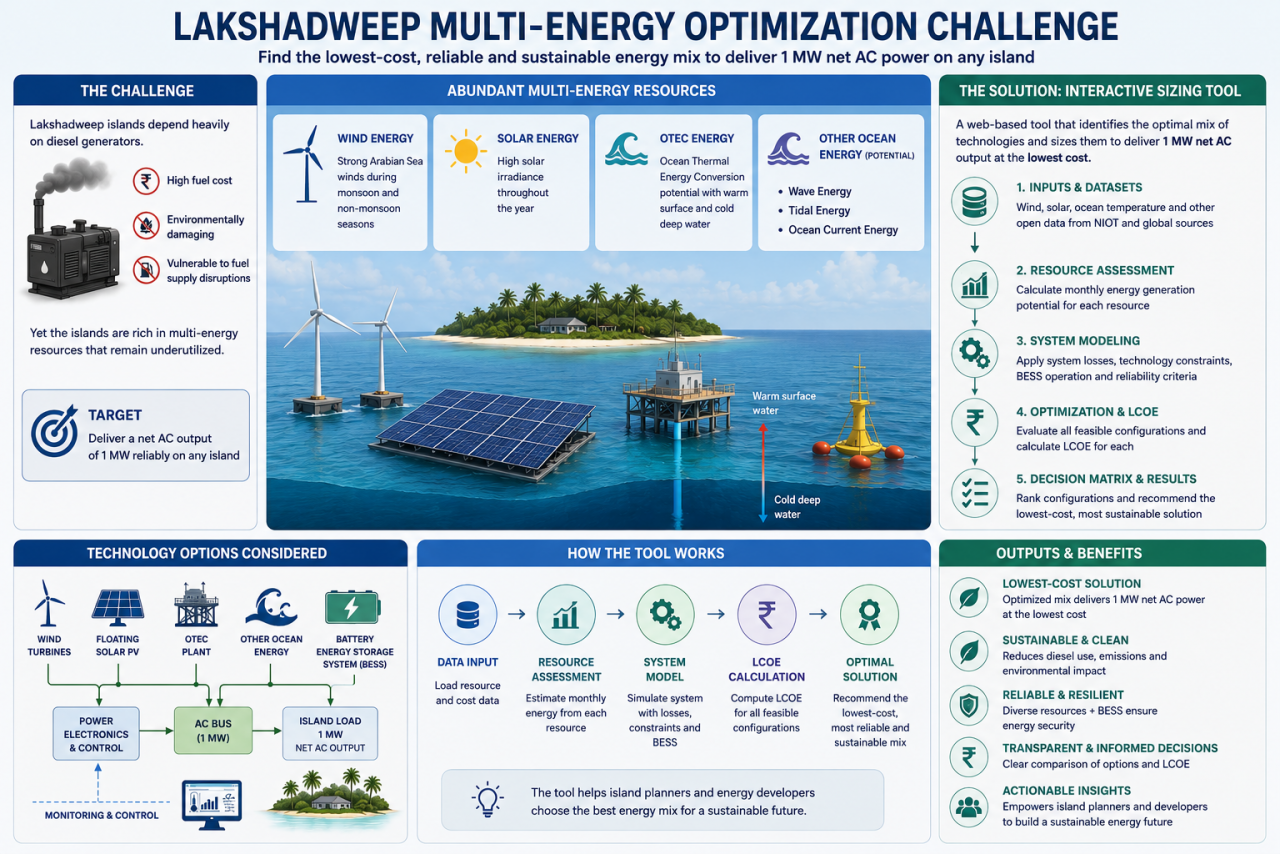
- Royalty free image (created using AI tool)
Chennai
- Organisation
- National Institute of Ocean Technology (NIOT)
- S S Prakash Kumar Lagudu
The Lakshadweep Islands currently depend heavily on diesel generators for electricity generation. While reliable, diesel-based power is costly, environmentally damaging, and highly vulnerable to fuel supply disruptions. At the same time, the islands are one of the richest multi-energy resource zones, they benefit from strong Arabian Sea winds, with average speeds of approximately 8 m/s during the monsoon season and 3.5 m/s during non-monsoon months; abundant solar resources, with average irradiance of 5.8 kWh/m²/day; and significant Ocean Thermal Energy Conversion (OTEC) potential, supported by a 22°C temperature difference between the sea surface and depths of 1,000 meters, which exceeding the 20°C threshold generally considered necessary for viable OTEC power generation. The challenge is to develop an interactive web-based sizing tool that identifies the optimal mix of wind turbines, floating solar photovoltaic (PV) systems, OTEC generation and any other ocean energy form supported by Battery Energy Storage Systems (BESS), to reliably deliver a net AC output of 1 MW on any Lakshadweep island. The tool evaluates each technology across key parameters including resource availability, capital & operational expenditure, reliability, and sustainability, and recommends the lowest-cost configuration capable of meeting the target load. Using datasets provided by the National Institute of Ocean Technology (NIOT), including LiDAR-measured wind speeds from Kadmat Island, solar radiation data from the Global Solar Atlas (GSA), NIOT ocean temperature profiles for Lakshadweep OTEC development and data from any open source, the platform calculates monthly energy generation for each resource, applies system losses, and estimates both Levelized Cost of Energy (LCOE) for every possible configuration. A decision matrix then ranks all technology combinations, enabling island planners and energy developers to identify the most cost-effective and sustainable solution.
You want to join the team:
- What the challenge owner would like to develop over 48h
- An interactive web-based decision-support tool with the following features:
1. Input panel: Island name, load target (default 1 MW AC), geographic coordinates
2. Pre-loaded static datasets: Monthly wind CF, solar GHI, and OTEC ΔT for
Lakshadweep and from any other open source (NIOT LIDAR wind speed, Global Solar Atlas GHI, NIOT OTEC temperature profiles)
3. Capacity sliders: User adjusts Wind (kW), Floating Solar (kW), OTEC (kW),
and BESS (kWh) to explore configurations
4. Calculation engine: Computes monthly power output per source, net AC output,
Plant Load Factor, LCOE, and carbon credits
5. Scoring matrix: Ranks each technology and each configuration combination
on Resource Potential, CAPEX, Reliability, Sustainability
6. Output: Ranked recommendation table + bar charts + radar chart
7. Export: Downloadable summary PDF/CSV for island planners
Tools: Microsoft Excel , Python
- Which skills the challenge owner is looking for
- Energy / Equivalent Engineer with ocean energy understanding, Process Engineer, Excel Analyst, Python UX / Communication Designer