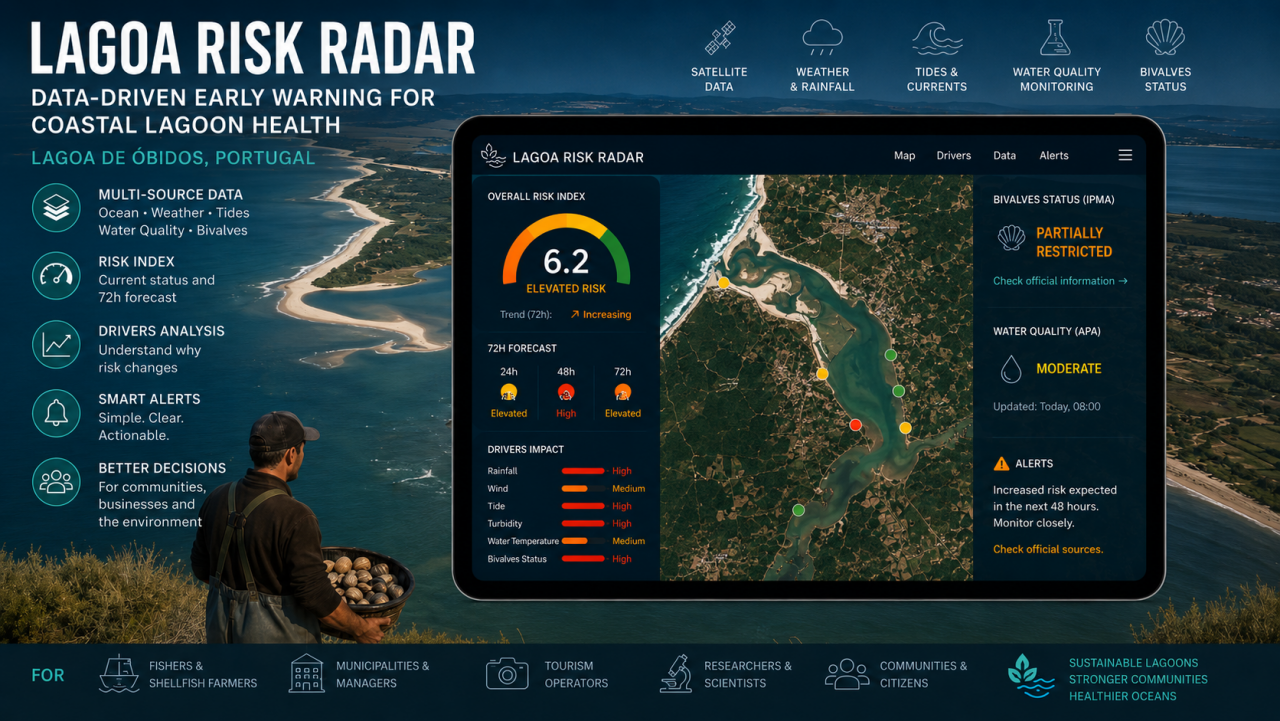
PEN02 - Lagoa Risk Radar - data-driven early warning for coastal lagoon health and local blue economy
- Image generated with ChatGPT/OpenAI by Rafael Bugia, 2026.
Peniche
- Individual
- Rafael Bugia
Coastal lagoons are highly productive but fragile systems. The Lagoa de Óbidos, in Portugal, supports shellfish harvesting, fishing, tourism, biodiversity and local identity, while facing recurring pressures such as sedimentation, water quality variation, management of the tidal inlet and restrictions on bivalve harvesting. The challenge is to build a simple decision-support prototype that combines open marine data, weather, rainfall, tides, satellite indicators and official bivalve/water-quality information to generate a clear operational risk score for the lagoon. The goal is not to replace official authorities, but to help municipalities, researchers, shellfish harvesters, tourism operators and local communities better understand when and why risk increases.
You want to join the team:
- What the challenge owner would like to develop over 48h
- We want to develop a working decision-support prototype for coastal lagoon risk monitoring.
The prototype will combine open marine, weather, tide, rainfall, satellite and official bivalve/water-quality data into a simple dashboard showing:
1. the current risk status of Lagoa de Óbidos;
2. a 72-hour risk tendency;
3. the main risk drivers, such as rainfall, tide, turbidity, water temperature and bivalve restrictions;
4. a map with lagoon risk zones;
5. clear alerts and recommended next actions for municipalities, shellfish harvesters, researchers, tourism operators and local communities.
The goal is not to replace official authorities, but to make fragmented marine and environmental data easier to understand and act upon.
- Which skills the challenge owner is looking for
- Marine biology; data analysis; GIS/mapping; web dashboard development; environmental science; oceanography; UX/data visualisation; local stakeholder knowledge