SCT02 - Rebuilding the Sea: Marine Recovery through Artificial Reefs under Floating Solar
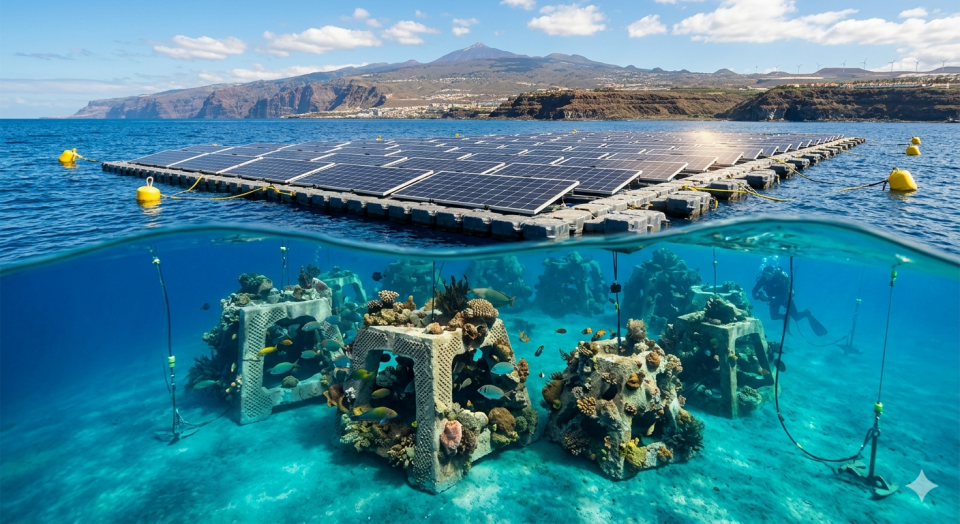
- AI-generated image · FormularioWebNeo S.L. · 2026
Santa Cruz de Tenerife
- Organisation
- FormularioWebNeo S.L.
- Daniel Llabrés
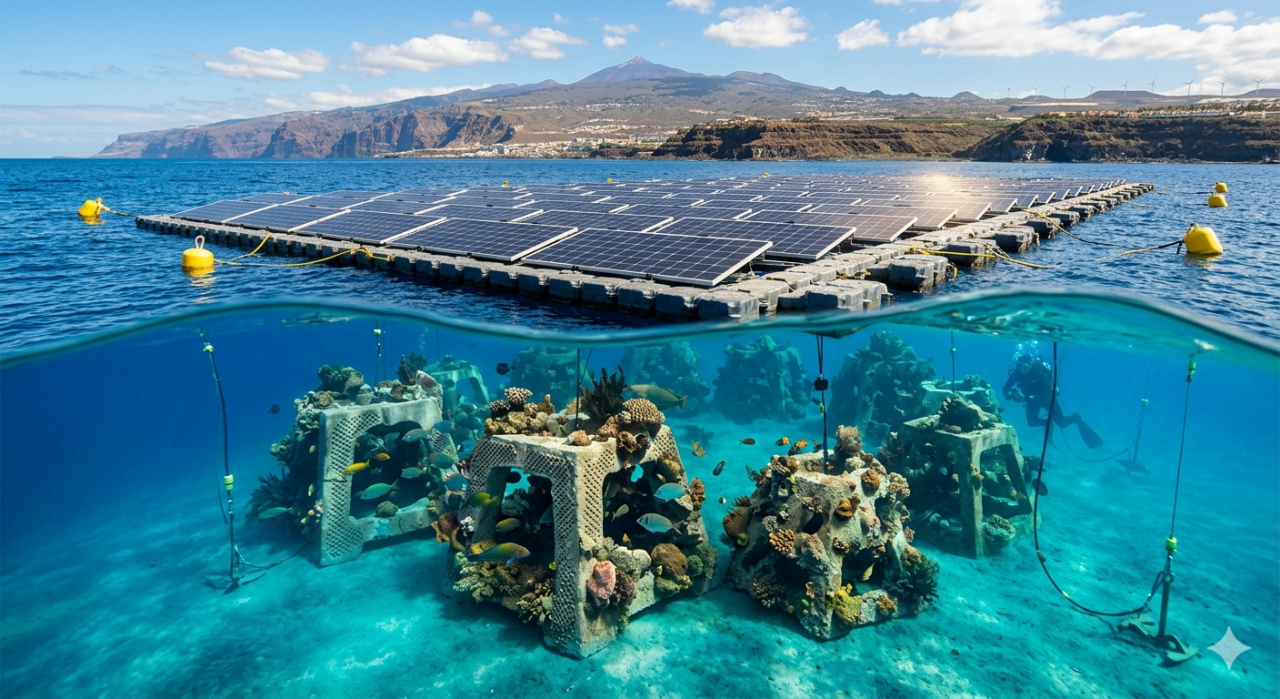
Between 2001 and 2023, 53 aquaculture cages operated in Playa Quemada bay (Lanzarote), devastating the seabed. Today the bay is dominated by invasive Caulerpa macroalgae, with no complex benthic structure remaining. Nearby Cymodocea nodosa meadows — a protected EU Habitats Directive habitat — are in documented regression (Innoceana, 2022). The bay was officially classified as prohibited for aquaculture by Spain's PROAC, confirming the ecological damage. FV Playa Quemada is a 6.4 MWp floating solar plant planned for this bay under Demarcación de Costas regulations. Its mooring system offers a unique opportunity: integrating artificial reef modules into the anchoring structures creates hard substrate for wild natural recruitment — restoring ecosystem complexity without any hatchery or captive breeding. Target species for spontaneous colonisation include: Diadema africanum (99.7% population collapse in the Canary Islands, 2022–2025; Cano et al. 2025), Sparisoma cretense (parrotfish), native macroalgae, garden eels, and benthic invertebrate communities. A 2024 UK/Honduras field study proved concrete artificial reef modules tripled adult Diadema density and increased juveniles 7× within two years — driven solely by habitat complexity, not captive breeding.
The challenge: using EMODNET bathymetry, Copernicus Marine thermal and current data, and species distribution records, build a data-driven model to optimise artificial reef placement, geometry, and density within the FV mooring grid to maximise natural biodiversity recovery.
- What the challenge owner would like to develop over 48h
- A spatial GIS model and interactive visualisation tool to optimise artificial reef deployment beneath the floating solar mooring system of FV Playa Quemada — a bay devastated by 53 aquaculture cages (2001–2023).
- Which skills the challenge owner is looking for
- Marine biologist (benthic ecology, artificial reef design)
Data scientist / GIS analyst (EMODNET, Copernicus Marine data)
Oceanographer (currents, thermocline, SST)
Environmental engineer (FV mooring and reef module design)
Python / web developer (data visualisation, Copernicus API)