BRE05 Seabream or not seabream?
- AI-generated concept image created for the "Seabream or Not Seabream?" challenge.
Brest
- Individual
- Jérôme Détoc
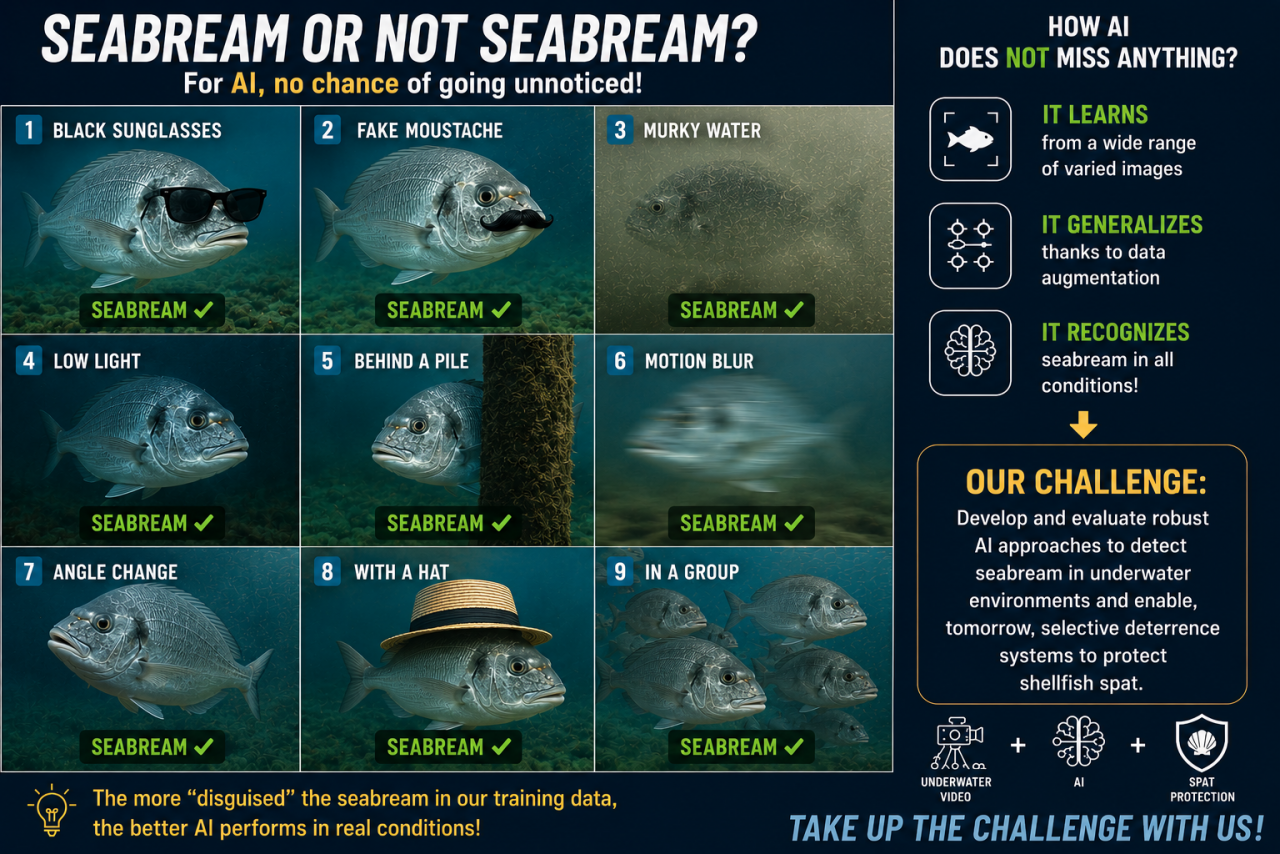
- Seabream seem to have developed a special talent: treating shellfish spat as an all-you-can-eat buffet. What if Artificial Intelligence could help us spot them before they sit down for dinner? This challenge aims to explore how underwater video and AI can contribute to the automatic detection of seabream in real-world conditions. The goal is not to build a complete operational system in 48 hours, but to identify and evaluate the AI building blocks that could eventually support selective deterrence systems designed to protect shellfish farms. Participants may work on topics such as: detecting seabream in underwater videos; dealing with challenging conditions such as turbid water, low light, motion blur, changing viewing angles and varying distances; evaluating existing data augmentation capabilities available in VIAME, an open-source platform dedicated to marine video analysis, annotation, tracking and AI-based detection; developing new augmentation strategies adapted to underwater environments; comparing human and AI recognition capabilities. Because knowledge sharing matters to us, we also hope to produce recommendations and reusable outcomes that can benefit the wider community. And because a hackathon should also be fun – and always have a Plan B – we are ready, if needed, to proudly host a giant quiz: "Seabream or Not Seabream?" Who will be best at recognizing a seabream: hidden behind a pole? swimming in very turbid water? seen from far away? mixed within a school of fish? or almost disguised like Kad Merad trying to stay incognito? By the end of the hackathon, we hope to deliver: technical recommendations; feedback on the most promising approaches; benchmarks and comparisons; and perhaps demonstrate that some seabream are much harder to spot than they think. This challenge brings together aquaculture, marine sciences, computer vision, artificial intelligence and open-source software around a concrete objective: improving the protection of shellfish spat through smarter underwater monitoring systems.
- What the challenge owner would like to develop over 48h
- Evaluation of existing data augmentation strategies available Comparison of different AI approaches and models. Integration or experimentation with open-source tools such as VIAME, DIVE, LitDet, Albumentations or PyTorch. Recommendations for future embedded or real-time deployments. Development of new marine-specific augmentation methods. (turbidity, low light, motion blur, occlusions, fish schools, etc.).
- Which skills the challenge owner is looking for
- Software development Artificial Intelligence & Machine Learning UX, visualization and communication